
Disclosure: This post contains affiliate links. If you purchase through these links, we may earn a small commission at no extra cost to you.
Sensitive skin and the teen years are a difficult combination. Hormonal changes are already making skin more reactive, and trying the wrong products can leave skin red, burning, and worse off than before. The mistake most sensitive-skin teens make is using too many products, switching too often, or reaching for the same acne treatments their friends use — without realizing their skin needs a completely different approach.
This guide covers exactly what sensitive teen skin needs, what to avoid, and how to build a routine that actually calms skin rather than aggravating it.
What Is Sensitive Skin in Teens?
Sensitive skin is not a medical diagnosis — it's a description of skin that reacts more readily to products, environmental factors, and stress than typical skin. In teens, sensitive skin often shows up as:
- Redness or flushing after applying new products
- Stinging, burning, or itching sensations
- Skin that feels tight, dry, or uncomfortable after cleansing
- Frequent reactions to fragranced products or certain ingredients
- Skin that takes longer to recover from breakouts, leaving marks for weeks
- Rosacea-like flushing across the nose and cheeks
Sensitive skin can be oily, dry, or combination — skin type and sensitivity are separate characteristics. A teen can have oily AND sensitive skin at the same time, which makes product selection especially tricky.
The Golden Rule: Less Is More
For sensitive teen skin, the single most important principle is simplicity. Every product you add is another potential irritant. A two or three product routine used consistently will always outperform a ten-step routine that introduces multiple actives your skin can't handle.
Dermatologists consistently recommend that sensitive skin patients start with the absolute minimum — cleanser, moisturizer, SPF — and only add one product at a time, waiting at least four weeks before introducing anything new. This makes it possible to identify exactly what your skin does and doesn't tolerate.
Ingredients to Avoid for Sensitive Teen Skin
Before covering what works, it's worth being specific about what sensitive skin teens should avoid — because many common teen skincare products contain these triggers:
| Ingredient to Avoid | Why It's Problematic | Common Hiding Places |
|---|---|---|
| Fragrance / Parfum | Leading cause of contact dermatitis and irritation | Cleansers, moisturizers, toners, serums |
| Denatured alcohol (SD alcohol) | Strips skin barrier, causes dryness and irritation | Toners, astringents, some serums |
| Essential oils | High allergen potential despite being "natural" | Natural/organic products, face oils |
| High-strength AHAs (10%+) | Over-exfoliates reactive skin, causes burning | Exfoliating toners, peels, pads |
| Physical scrubs | Micro-tears in skin barrier, spreads bacteria | Face scrubs, exfoliating cleansers |
| Retinol | Too strong for sensitive teen skin at any % | Anti-aging products, some serums |
| Sulfates (SLS/SLES) | Harsh surfactants that strip the skin barrier | Foaming cleansers, body wash |
| Witch hazel | High tannin content, drying and irritating | Toners, acne products |
The 3-Step Sensitive Skin Routine for Teens
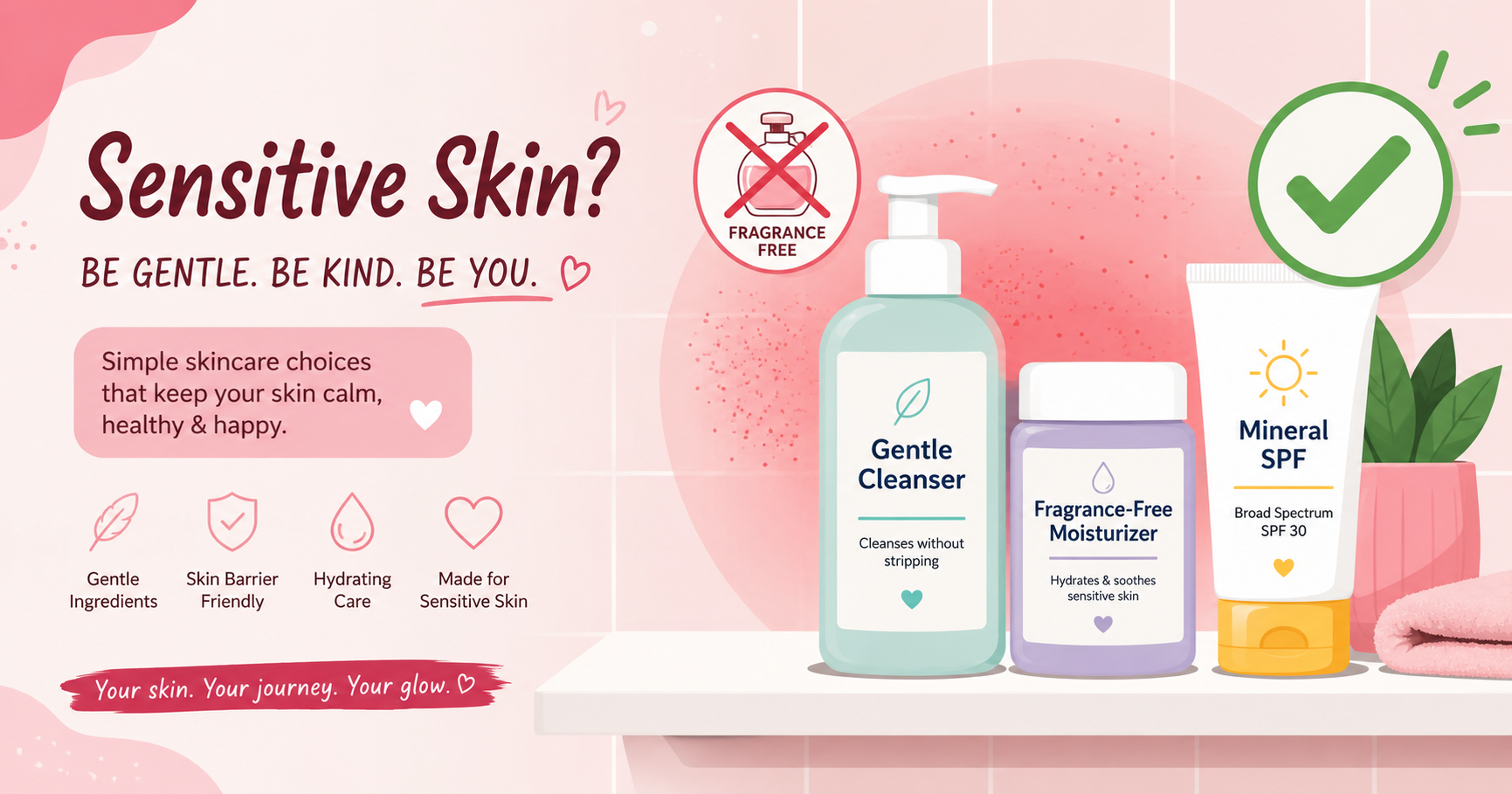
Morning: Fragrance-free gentle cleanser → Lightweight moisturizer → Mineral SPF 30+
Night: Fragrance-free gentle cleanser → Lightweight moisturizer
Step 1 — Fragrance-Free Gentle Cleanser
For sensitive teen skin, the cleanser is the most important product to get right. You need something that removes oil and environmental debris without stripping the skin's natural protective barrier.
Look for: fragrance-free, sulfate-free, pH-balanced, non-foaming or low-foam formula. Avoid anything described as "deep cleansing," "pore purifying," or "oil control" — these tend to be too stripping for sensitive skin.
Top picks:
- CeraVe Hydrating Facial Cleanser 🛒 Shop — the gold standard for sensitive skin. Ceramides, hyaluronic acid, no fragrance. Leaves skin comfortable, never tight. $14.
- Cetaphil Gentle Skin Cleanser 🛒 Shop — ultra-minimal formula, dermatologist favourite for reactive skin for decades. $12.
- La Roche-Posay Toleriane Hydrating Gentle Cleanser 🛒 Shop — specifically formulated for sensitive and intolerant skin. Contains prebiotic thermal water. $15.
Wash with lukewarm water — never hot. Pat dry gently — never rub.
Step 2 — Lightweight Fragrance-Free Moisturizer
Sensitive skin often has a compromised skin barrier — the protective layer that keeps moisture in and irritants out. A good moisturizer helps repair and strengthen this barrier, which over time makes skin less reactive overall.
Look for: ceramides, hyaluronic acid, niacinamide (calms redness), fragrance-free, non-comedogenic. Avoid: fragrance, essential oils, alcohol high on the ingredient list.
- CeraVe AM Facial Moisturizing Lotion SPF 30 🛒 Shop — ideal morning moisturizer. Ceramides + SPF in one lightweight lotion. Non-comedogenic. $16.
- CeraVe PM Facial Moisturizing Lotion 🛒 Shop — night moisturizer with niacinamide to calm redness over time. Ultra-lightweight. $16.
- Vanicream Moisturizing Skin Cream 🛒 Shop — the cleanest ingredient list available. Free of dyes, fragrances, parabens, and formaldehyde releasers. Best for extremely reactive or allergy-prone skin. $14.
Step 3 — Mineral Sunscreen (Morning Only)
For sensitive skin, mineral sunscreens are strongly preferred over chemical ones. Mineral sunscreens use zinc oxide or titanium dioxide which sit on top of skin and physically block UV rays. Chemical sunscreens absorb into the skin and convert UV to heat — a process that can trigger redness and irritation in sensitive skin.
- EltaMD UV Clear Broad-Spectrum SPF 46 🛒 Shop — the top dermatologist recommendation for sensitive and acne-prone skin. Contains niacinamide. Lightweight, no white cast. $39.
- La Roche-Posay Anthelios Mineral SPF 50 — gentle mineral formula, water-resistant, excellent for sensitive skin. $36.
- CeraVe AM Facial Moisturizing Lotion SPF 30 🛒 Shop — budget option that combines moisturizer and SPF. Fine for most sensitive skin, though it contains chemical filters so patch test first.
What About Acne on Sensitive Skin?
This is the hardest part — many acne treatments are too harsh for sensitive skin and cause more irritation than the acne itself. Here's how to approach it carefully:
Start here: Gentle cleanser twice daily + consistent moisturizer. This alone clears mild breakouts in many sensitive-skin teens by reducing the inflammation caused by harsh products they were using before.
If needed, add: Low-concentration salicylic acid (0.5%) in a wash-off cleanser only, used once daily at night. Wait 4 weeks before assessing.
If still needed: Niacinamide leave-on product to reduce inflammation and redness without the irritation risk of BHAs.
If none of that works: See a dermatologist. Sensitive-skin acne often responds better to prescription topicals than anything available over the counter.
Never use benzoyl peroxide, retinol, or high-strength AHAs on sensitive skin without dermatologist guidance. These are effective for many teens but genuinely too irritating for reactive skin types.
Patch Testing — The Non-Negotiable Step
Sensitive skin teens should patch test every new product before applying it to their face. Here's how:
- Apply a small amount of the new product to the inside of your wrist or behind your ear
- Leave it for 24 hours without washing
- If no redness, itching, or burning appears, it's likely safe for your face
- Apply to a small area of your face for 3-4 days before using fully
This adds time but prevents the frustrating cycle of a full-face reaction that takes weeks to calm down.
Lifestyle Factors That Affect Sensitive Teen Skin
Products are only part of the picture. These non-product factors have a significant impact on sensitive skin:
- Pillowcase material: Synthetic fabrics can irritate sensitive skin. Switch to 100% cotton pillowcases and wash them every 2-3 days.
- Water temperature: Hot showers and hot water when cleansing trigger redness and inflammation. Always use lukewarm water.
- Towels: Use a soft, clean towel for your face only. Pat — never rub.
- Laundry detergent: Fragrance in detergent transfers to pillowcases and can trigger nightly reactions. Switch to a fragrance-free detergent like All Free & Clear.
- Diet and stress: High-stress periods and high-glycemic diets can worsen skin sensitivity and inflammation. Not within everyone's control, but worth being aware of.